

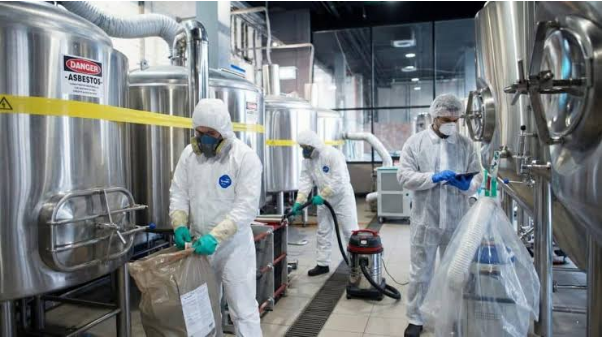
Many older Australian structures, including commercial and public facilities, as well as industrial sites, contain asbestos. While the underlying health risks are the same, removing asbestos from an industrial setting can be far more difficult than a smaller-scale cleanup effort.
Industrial sites frequently contain considerable asbestos-containing materials (ACM), aged infrastructure, stationary plant, insulation, roofing products, and other materials that may have been placed decades ago. The work may also have to take place around active operations, heavy machinery, and multiple contractors. As a result, industrial asbestos removal services necessitate meticulous planning, advanced controls, and a thorough grasp of workplace health and safety regulations.
Understanding these distinctions can assist facility owners, property managers, and project teams in planning asbestos-related work more responsibly.
1. Industrial asbestos removal involves a more complex working environment
One of the most significant changes is the setting in which the activity takes place.
A small commercial facility may require the removal of asbestos-containing wall sheeting, flooring, or roofing materials from a relatively small area. In contrast, asbestos may be present in various structures as well as plant, equipment, and services at an industrial complex.
Materials may be located in areas such as:
- Factories and manufacturing facilities
- Warehouses and distribution centres
- Power and utility infrastructure
- Workshops and processing plants
- Industrial roofing and wall systems
- Pipework, boilers or older plant
- Electrical and mechanical components
The size and position of the substance can make access, containment, and sequencing more difficult. Work may also need to be coordinated with manufacturing schedules, other contractors, and site-specific dangers.
2. Identification and planning are critical
Industrial asbestos removal should not begin just because a substance resembles asbestos. Suspected ACM must be properly examined, with data recorded in the workplace asbestos register if relevant.
Under the model WHS framework, establishments with asbestos or ACM must manage the associated hazards, which include keeping an asbestos registry and an asbestos management plan. Requirements differ between Australian jurisdictions, so always consult the appropriate state or territory regulator.
3. Understanding what is actually being removed
Industrial facilities may contain both non-friable and friable asbestos materials. Friable asbestos is easier to crumble or reduce to powder, and if disturbed, it can release more airborne fibres.
The condition, quantity, location, and accessibility of the material all have an impact on how the removal job is organised. An experienced project team will take these aspects into account before deciding on appropriate controls.
4. Containment can be more demanding on industrial sites
Industrial premises frequently have extensive work areas, interconnecting rooms, ventilation systems, and many entrance points. These qualities can make limiting the spread of asbestos contamination critical.
Depending on the conditions, controls may include establishing a clearly defined asbestos work area, controlling access, implementing adequate containment measures, and providing appropriate decontamination arrangements.
Safe Work Australia’s model Code of Practice for Asbestos Removal contains regulations and recommendations for work spaces, access restrictions, decontamination, waste management, clearance inspections, and air monitoring for licensed removal work.
The goal is not just to remove the substance. The method must also protect workers, other contractors, and local residents from unnecessary exposure to airborne fibres.
5. Industrial work often needs closer coordination with other operations
A factory or processing facility cannot always be considered as an empty structure.
Forklifts may be moving throughout the site, production lines may be running nearby, contractors may be performing maintenance, or workers may be gaining access to critical utilities. Some facilities also have confined areas, electrical dangers, operating at heights, and hazardous plant.
This means that asbestos removal must be included into the site’s overall safety planning rather than handled as a separate activity.
For example, a facility undergoing renovations may require asbestos removal before electricians, plumbers, or demolition contractors can begin their work safely. Poor sequencing can lead to unnecessary exposure risks and potentially delay the overall project.
6. How industrial work differs from commercial asbestos removal
There is a great deal of overlap between industrial and commercial asbestos removal services, especially when work is being done in the workplace. Both may necessitate the use of licensed removalists, proper planning, containment, waste controls, and adherence to all applicable WHS regulations.
The distinction is frequently the complexity and scale of the environment, rather than a distinct set of safety standards.
A commercial office refurbishment may include a small number of asbestos-containing items in predictable locations. An industrial project may have many buildings, large areas of ACM, active plant, and a variety of occupational risks.
This may necessitate more precise coordination among the asbestos removal contractor, facility management, occupational health and safety experts, engineers, and other trades.
7. Licensing and regulatory requirements matter
The standards for asbestos removal in Australia vary by state and territory. According to the model WHS framework, Class A and Class B asbestos removal permits apply to distinct types of work, but in some limited cases, tiny amounts of non-friable asbestos may be removed without a licence. Always check state and territory requirements before beginning work.
Depending on the nature of the operation, licensed removal work may additionally require an asbestos removal control plan, notice to the regulator, adequate supervision, access controls, waste management, and clearance processes.
This is one reason why industrial asbestos projects should be evaluated separately rather than presuming that approaches utilised on a smaller work would always be appropriate.
8. Waste management is part of the removal process
Asbestos removal does not cease after the material leaves the work area. Asbestos waste must be properly contained, tagged, transported, and disposed of at a facility that is approved to accept it.
Industrial projects can generate a large amount of asbestos waste, especially when old roofing, cladding, or other construction materials are being removed. As a result, waste management must be integrated into the project from the beginning.
According to Safe Work Australia’s guidance, waste containment and disposal are part of the asbestos removal tasks.
9. What should facility owners consider before removal?
Before launching an industrial asbestos project, property and facility managers should establish:
- Where asbestos or suspected ACM is located
- Whether relevant asbestos registers and management plans are current
- What type and condition of material is present
- Whether licensed removal is required
- How the work will interact with normal site operations
- What access, containment and decontamination controls are needed
- How asbestos waste will be handled and disposed of
- What clearance or verification processes apply before an area is returned to normal use
A well-planned project can also help to minimise interruption by scheduling removal activities around maintenance shutdowns, refurbishment stages, or other planned tasks.
10. The key difference is the level of planning
Industrial asbestos removal isn’t just a bigger version of a standard asbestos job. The surrounding workplace, material size, site risks, and interface with ongoing operations can all influence how the work is managed.
For facility owners, the ideal strategy is to address asbestos as a specialised workplace risk from the start of a project. Appropriate evaluation, qualified professionals as needed, documented controls, and adherence to appropriate state or territorial laws can all help ensure that removal is completed without exposing workers or others to unnecessary risks.
Safe Work Australia provides national model guidance, but underlines that asbestos regulations are governed by each state and territory. Anyone intending asbestos removal should confirm the requirements in the jurisdiction where the work will be performed.